Via Ferrata Kaiser Max
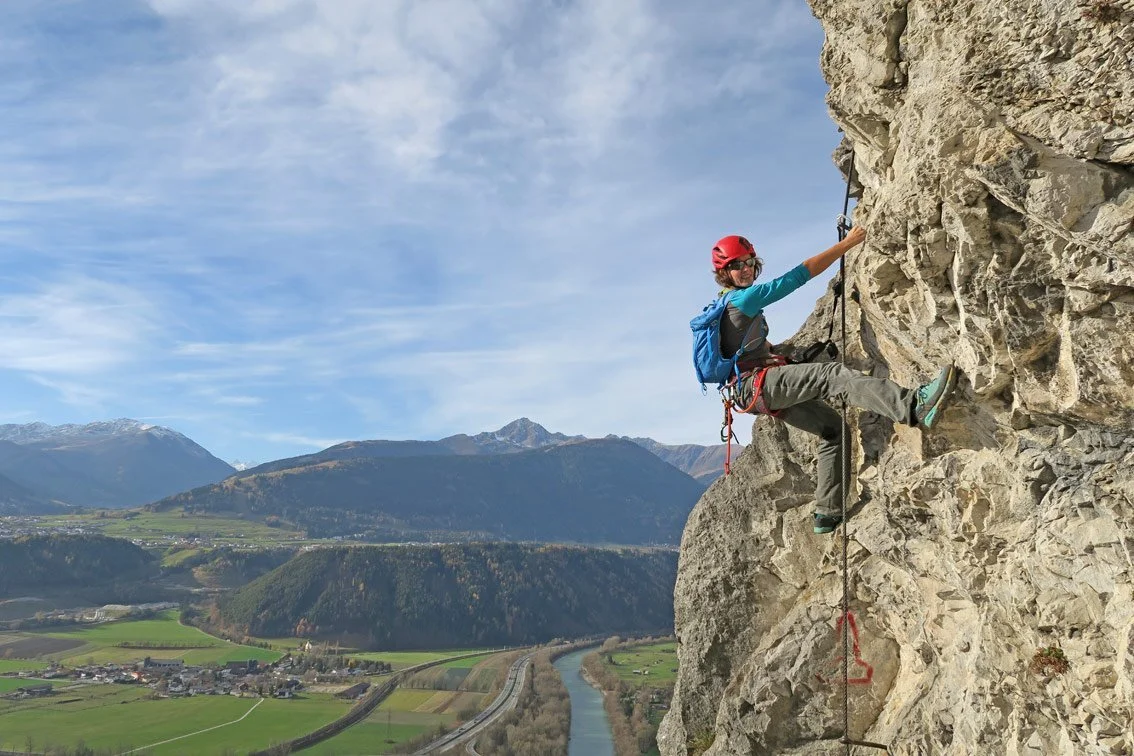
The Kaiser Max Klettersteig is a legendary via ferrata route carved into the sheer cliffs of the Martinswand above the Inn Valley near Zirl and Innsbruck in Tyrol, Austria. It is widely regarded as one of the most challenging “sport” via ferratas in the Eastern Alps, demanding strength, nerves, and technical ability.
For adventurers seeking a high-adrenaline climb rather than a scenic stroll, this route delivers. Its steepness, exposure and sustained difficulty place it firmly in the “serious mountaineering via ferrata” category.
Trail Overview
Name: Kaiser Max Klettersteig (also called Kaiser Max Via Ferrata)
Location: Martinswand cliff, above Zirl/Innsbruck, Tyrol, Austria
Distance & elevation gain: Approx. 3 km total route (climb section), ascent ~414 m, descent similar.
Difficulty grade: Class E (very difficult) via ferrata with sections D/E and significant vertical overhangs.
Time needed: Approach ~10–15 minutes, climbing ~2.5–4 hours depending on pace and variant, descent ~1 hour.
Aspect/seasonality: South-facing wall, accessible much of the year thanks to its sun-exposure.
Route Description
The route consists of three major sections:
Section I – Warm up and initial climb
From the marked parking below the Martinswand, a short forest trail brings you to the base. The via ferrata starts with steep terrain in C/D grade, then features a ramp with easier A/B sections, a leftwards traverse, and another steep climb up to the Maximilian Grotto.
Section II – The “Direttissima” / Main challenge
After the grotto you face the true heart of the route: a near-vertical wall of ~100 m or more, with minimal foot-holds and heavy reliance on upper-body strength. Difficult grades climb to D/E or even pure E, with overhangs and full exposure above the Inn Valley floor. Many guides state this is the reason the route stands out.
Section III – Descent or alternative exit
From the upper exit you can choose to keep going through further challenging passages (for very fit climbers), or take the descent path down via the grotto and a marked path back to the road. The descent contains secured A/B sections but still demands concentration due to loose rock.
Throughout, you’re always aware of the 600-m high cliff face beneath you and the valley winding below, making the visuals as intense as the physical.
Highlights
Pure vertical drama: The second section’s 100 m nearly vertical slab is iconic and one of the hardest sustained via ferrata segments in the Alps.
Epic exposure: Climbers traverse and ascend with the Inn Valley stretching out below, giving an unforgettable sense of altitude and risk.
Short approach, big payoff: The climb starts almost at the road/parking, meaning you spend your effort on the cliff rather than long approach trails.
Year-round accessibility: Thanks to south-facing location, the route is often usable outside the height of summer, offering more flexibility for training or shoulder seasons.
Historic rock & setting: Martinswand is a dramatic limestone face with storied alpine history, and the via ferrata ties into that heritage.
Difficulty & Required Skills
This is not a via ferrata for novices. Key elements:
Grade: E (with D/E) — extremely demanding in via ferrata grading.
Fitness: Excellent upper-body strength, stamina and leg strength for sustained climbing.
Technical ability: Confident on rock, very good footwork, able to manage minimal holds and steep terrain. Use of climbing or approach shoes recommended.
Mental strength / exposure tolerance: At times, you’ll be 200-300 m above the valley floor, meaning you must be comfortable with height, exposure and vertical drop.
Gear: Full via ferrata kit (helmet, harness, energy-absorbing lanyard), gloves, reliable footwear, possibly a lightweight rope or sling for extra self-protection if desired.
Navigation & descent: You must plan the descent route and know where to exit if you wish to pull out early. One wrong move on the descent path can lead to serious trouble.
When to Go
Best season: Late spring to early autumn — mid-May to October generally offers the best weather and minimal snow on the wall.
Avoid: Heavy rainfall (rock becomes slippery), strong winds or thunderstorms (exposed cliff).
Time of day: Go early in the day to avoid sun‐exhaustion on the vertical wall; the face is south-facing, so afternoon sun can heat the rock.
Shoulder seasons: Because of the exposure and south aspect, early season (May) and late season (Sept/Oct) may be feasible — though check local conditions.
Access & Logistics
Getting there: Take the A12 motorway (Kufstein–Landeck) to the exit Zirl Ost. Then follow the B171 federal road towards Innsbruck. A parking lot is located at the base of Martinswand.
Approach: 10–15 minutes walk from the parking lot via a forest path to the entrance of the via ferrata.
Descent: If you choose the standard exit, from the top you follow a marked path down via Maximilian Grotto, then through a quarry path, finally returning to the road/parking. As an alternative more advanced exit, you can continue climbing further.
Time required: Plan for a full morning or early afternoon, 3–5 hours total including approach and descent.
Supplies: There is no service mid-route; bring water, snacks, sun-protection, and leave no waste.
Safety check: Always inspect the via ferrata kit, rock condition (loose stones possible), weather forecast and your own condition. Exit early if unsure.
Why It Belongs on Every Adventurer’s List
The Kaiser Max Klettersteig is more than just a via ferrata: it is an alpine benchmark — a test of strength, skill and nerve in one of Europe’s classic vertical arenas.
It offers high-adrenaline climbing with dramatic exposure rarely matched by easier routes.
It’s accessible yet elite: a short drive from Innsbruck, yet delivering one of the most challenging climbs of its type.
It lends an unforgettable sense of achievement: reaching the upper wall, hanging over the valley, looking out across the Inn River far below… moments you’ll remember forever.