Via Ferrata Gebirgsvereinssteig
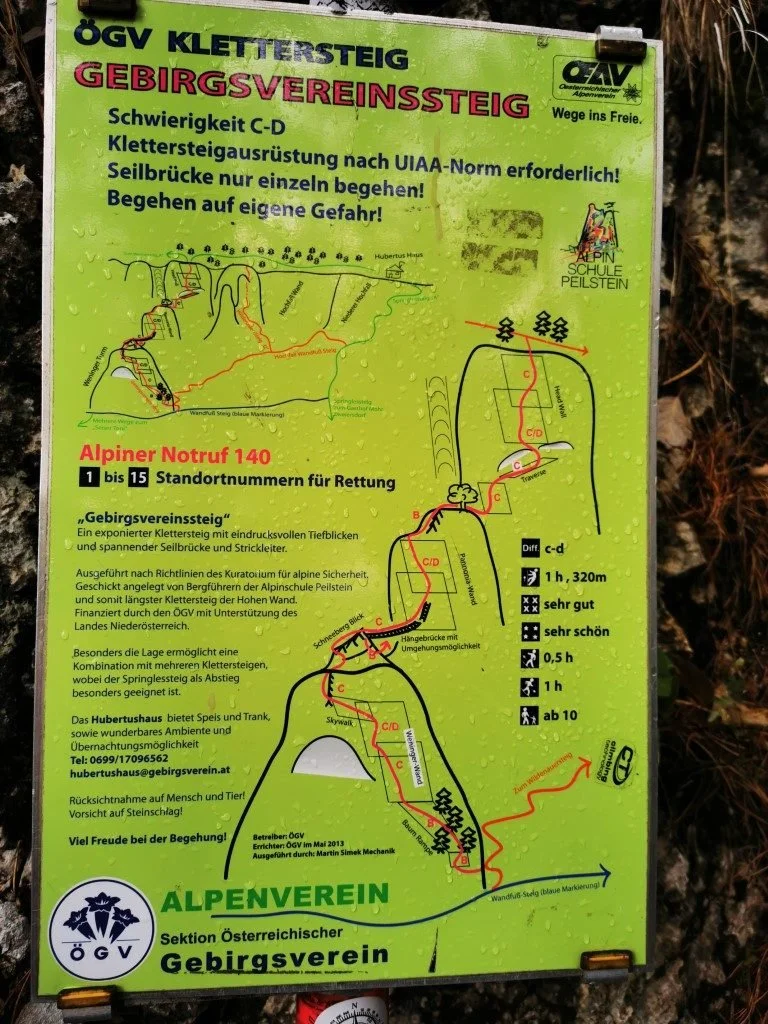
Hidden within the limestone cliffs of the Hohe Wand Nature Park in Lower Austria, the Via Ferrata Gebirgsvereinssteig is one of the most exhilarating and scenic fixed-rope routes near Vienna. Combining vertical ascents, airy traverses, and jaw-dropping panoramas, this route captures the essence of what makes via ferrata adventures so compelling — exposure, endurance, and unforgettable views.
Introduction
The Gebirgsvereinssteig via ferrata, located on the steep southern wall of the Hohe Wand plateau, is one of the most popular ferratas in eastern Austria. It is famous for its sustained exposure, technical passages, and a thrilling sequence of ladders and iron rungs that climb nearly 250 meters straight up the cliff.
Despite being just an hour from Vienna, it feels remote and wild — a pure alpine experience accessible even to those based in the city. The combination of dramatic limestone walls, forests below, and vast views of the Pannonian plain makes it a true classic of the region.
Trail Overview
Location: Hohe Wand Nature Park, Lower Austria
Nearest Town: Maiersdorf / Grünbach am Schneeberg
Length: Approx. 350 meters of vertical climbing
Elevation Gain: Around 250 meters
Duration: 1.5–2.5 hours (via ferrata only; total round trip 3–4 hours)
Difficulty Grade: D (Austrian scale) – difficult
Altitude: Starts at about 800 m, finishes near 1,050 m
Route Type: Via ferrata ascent followed by a hiking trail descent
Equipment: Via ferrata set (Y-lanyard, harness, helmet, gloves)
Character: Steep, exposed, athletic climbing on solid limestone
The route requires both physical and mental endurance, offering a combination of pure vertical walls, airy traverses, and short resting ledges.
Route Description
The Gebirgsvereinssteig begins at the base of the Hohe Wand cliffs, accessible from the Seiser Toni car park or the nearby Maiersdorf trailhead.
The start immediately sets the tone — a steep, slightly overhanging section demanding confidence and strength. The line follows a continuous cable, leading up a dramatic wall studded with iron rungs.
Midway, a long traverse across an exposed ledge offers a brief respite and spectacular views over the valley. From here, the route climbs again through alternating vertical and diagonal sections, sometimes forcing climbers to stretch and balance delicately on small footholds.
The key section comes just before the exit: a short but powerful overhang that requires upper-body control and precise footwork. After overcoming this, the ferrata eases into a gentler slope leading to the plateau’s edge, where a panoramic trail continues through pine forest to the top viewpoint near Skywalk Hohe Wand.
The descent follows a marked hiking trail that loops back to the base, taking about 45–60 minutes.
Highlights
Spectacular exposure: sheer drops and endless views over the Vienna Basin.
Varied climbing: vertical walls, traverses, and overhangs on perfect limestone.
Historic route: one of the earliest established ferratas in the Hohe Wand area, maintained by the Austrian Alpine Club.
Wildlife and nature: eagles, chamois, and alpine flora typical of the limestone plateau.
Accessibility: only about an hour from Vienna, yet offering a genuine alpine experience.
Difficulty and Required Skills
The Gebirgsvereinssteig is rated D on the Austrian via ferrata scale (equivalent to K4–K5 on the international Hüsler system).
This means sustained difficulty, with strenuous, vertical, and often exposed climbing.
Required skills and preparation:
Good physical condition and upper-body strength for pulling through vertical sections.
Solid footwork and balance on small iron steps.
Mental focus and comfort with exposure — the route offers minimal resting ledges.
Proficiency in using via ferrata equipment and clipping safely.
The ferrata is not recommended for beginners. Those new to the sport should first practice on easier routes such as the Wandfußsteig or Weg der Freiheit before attempting this one.
When to Go
The best season runs from April to October, when the rock is dry and weather stable.
Spring (April–May): cool temperatures, occasional snow patches early in the season.
Summer (June–August): ideal conditions, though midday sun can make the rock hot. Start early or late.
Autumn (September–October): clear skies and cooler air, often the best season for climbing.
Avoid the route after rain or during thunderstorms — the exposed steel cables can become hazardous, and the limestone becomes slippery.
Access and Logistics
Starting Point:
Park at the Seiser Toni guesthouse or the Small Car Park Maiersdorf. Both are near the base trail that leads to the ferrata entrance (approx. 20–30 min walk).
How to Get There:
By Car: From Vienna, drive south on A2 towards Wiener Neustadt, then follow signs for Grünbach am Schneeberg and Maiersdorf (approx. 1h 15min total).
By Train: Take the train to Wiener Neustadt, then a regional bus to Maiersdorf. From there, a short walk leads to the Hohe Wand trail network.
Facilities:
Hohe Wand Nature Park has several huts and restaurants near the plateau top — notably the Skywalk Inn and Wilhelminenhaus hut, both offering food and panoramic terraces.
Accommodation available in Maiersdorf, Grünbach, and Stollhof.
The descent from the top connects to multiple hiking trails across the nature park.
Why It Belongs on Every Adventurer’s List
The Gebirgsvereinssteig represents the essence of Austrian via ferrata climbing — athletic, exposed, and set in breathtaking scenery. Its proximity to Vienna makes it one of the most accessible yet rewarding routes in the region, offering a full alpine experience without needing to travel deep into the mountains.
Climbing it is a test of both body and mind. Each section challenges endurance and courage, while the summit rewards you with sweeping views over the Pannonian plain and the distant silhouettes of Schneeberg and Rax.
It’s a route that reminds every climber why via ferrata is so addictive: the perfect blend of safety, exposure, and pure mountain freedom.