Via Ferrata Drachenwand
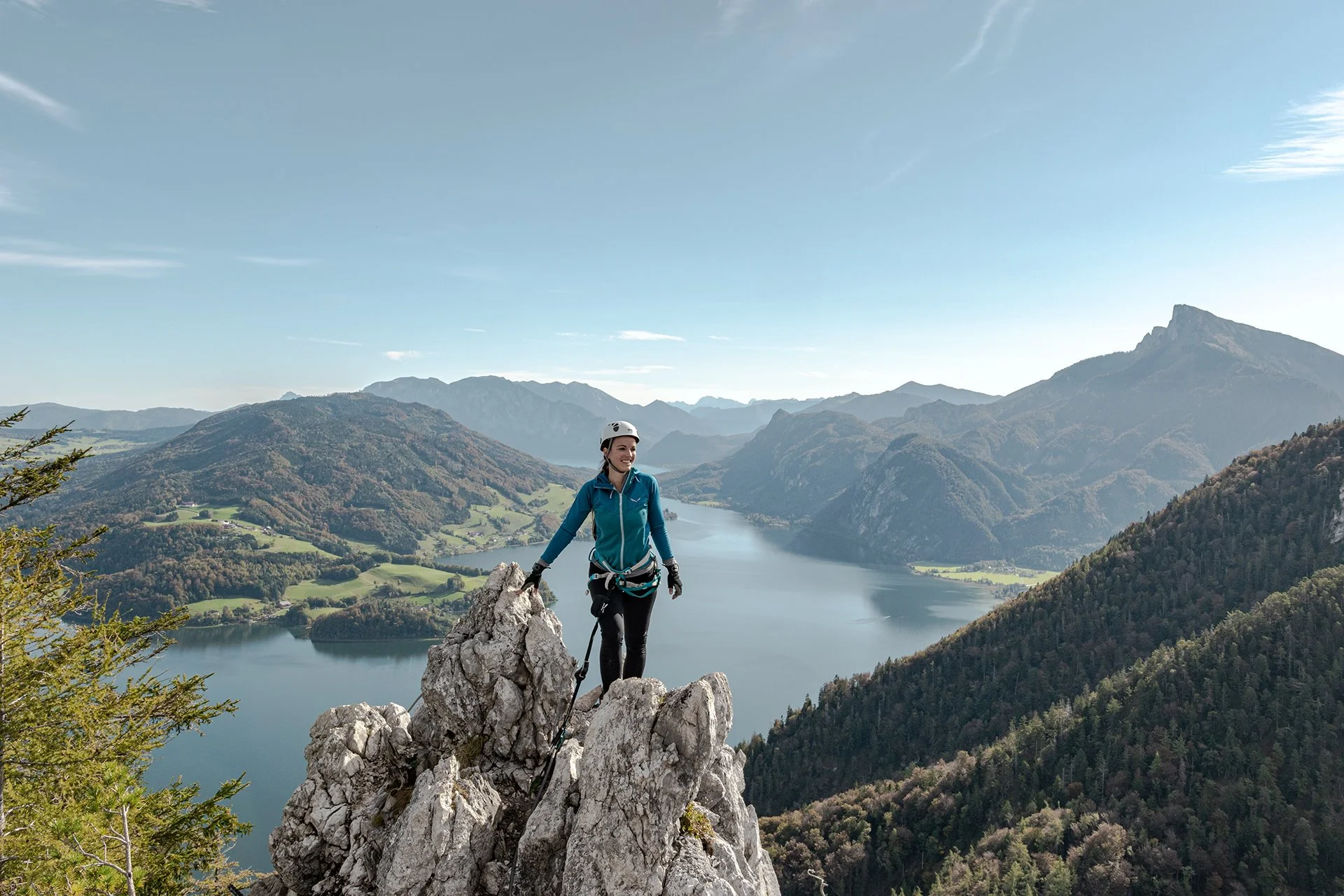
The Drachenwand Klettersteig (also known as “Dragon Wall via ferrata”) is one of Austria’s most scenic and rewarding via-ferrata routes. Perched above the turquoise waters of Mondsee in the Salzkammergut region, it rises via the east ridge of the Drachenwand limestone escarpment to a summit at around 1,060 m. With dramatic exposure, a famous rope-bridge section, and sweeping views over lake and mountains, it offers both thrill and panorama.
Constructed in 2008 and rapidly gaining popularity, this route combines the adrenaline of a secured climb with accessible logistics. While it avoids the extreme heights of high-alpine ascents, it remains a serious undertaking and deserves full attention and preparation.
Trail Overview
Location: Above St. Lorenz / Mondsee, Upper Austria / Salzburg border, Austria.
Type: Via ferrata (Klettersteig) along the east ridge of Drachenwand.
Ascent: Approximately 400-560 m of vertical gain on the ferrata section.
Length / Time: Approach ~20-30 min; ferrata climb ~2-3 h; descent ~1-1.5 h. Many sources list around 4 h total.
Difficulty Grade: Generally rated C (with optional variant C/D) in the German/Austrian Klettersteig grading system.
Summit Elevation: Approx. 1,060 m above sea level.
Route Description
The route begins at the parking area near Gasthof Drachenwand (St. Lorenz / Mondsee region). From there, a short forested approach leads to the start of the secured climb.
Start & Early Climb: The initial section rises via ladders and fixed cables up a steep wall of limestone. The route soon emerges onto the east ridge, offering the first views of Mondsee lake below.
Mid Section & Rope Bridge: One of the signature features is a rope-bridge or net ladder section spanning a dramatic gap (sometimes rated C/D). One variant bypasses it for a slightly more difficult but less exposed route.
Upper Ridge & Summit Ascent: After the more exposed mid sections, the route moves onto a jagged ridge leading to the summit cross of Drachenwand at ~1,060 m. The terrain remains secured but may be less artificially aided. From the summit, panoramic views open across the Salzkammergut lake district and the Dachstein massif.
Descent: The descent is not trivial. A marked route (often the Hirschsteig) leads through the “Drachenloch” rock window and down into forest and valley. The descent is steep and partially unsecured; care and sure-footing are important.
Highlights
Panoramic views: From the summit and ridge you get expansive views over Mondsee, the Salzkammergut lakes, and the Dachstein massif — a magnificent alpine panorama.
Rope bridge section: A thrilling exposed segment that spans a gap, offering dramatic visuals and the sense of being suspended above the valley.
Classic via ferrata atmosphere: With well-installed cables, ladders and fixed equipment, the route provides a clear “iron path” experience with alpine character.
Accessible yet alpine: Unlike very high-altitude routes, this one lies at moderate elevation (~1,000 m) but still delivers serious exposure and climbing challenge.
Descent through “Drachenloch”: The rock window near the descent offers another striking viewpoint of the lake below.
Difficulty and Required Skills
While not among the most extreme via ferratas, this route is not for beginners or casual walkers. Key considerations:
Grade C (variant C/D): The via ferrata is rated about C on the standard scale, with some sections reaching C/D if opting for the more direct variant.
Stamina required: With around 400-560 m vertical gain and 2-3 hours of climbing, good physical condition is needed.
Sure-footedness & head for heights: Exposure is substantial; the ridge and bridge sections demand confidence and good balance.
Descent not to underestimate: Many accidents occur on the descent. The route back is steep and partly unsecured, so don’t assume the climb is the end.
Equipment: A via ferrata set (y-lanyard with energy absorber), helmet, gloves and good boots are essential. Rain or wet rock increases risk significantly.
Navigation / Route Exit: While the ascent route is secured and clear, the descent requires paying attention to signage and walking paths.
In short: this is a moderate to demanding via ferrata, suitable for climbers with prior secured-route experience and mountain sense.
When to Go
Season: Best between May to October when the route is free of snow and the rock is dry.
Weather: Pick a day with stable weather; avoid if thunderstorms are forecast. The route is exposed and wet rock increases danger.
Time of day: Start early to avoid crowds (this route is popular) and ensure you are off the descent path before fading light.
Water/Conditions: After rain the descent can become slippery; some guides warn the route should only be attempted in dry conditions.
Access & Logistics
Nearest Village / Parking: The entry is near St. Lorenz on the western shore of Mondsee. Parking available near Gasthof Drachenwand with approach signs to the Klettersteig.
Approach Time: Around 20-30 minutes from parking to the via ferrata start.
Descent Route: After the summit, follow marked path/rope route into the valley (Hirschsteig or similar). This takes ~1-1.5 h and leads back to parking.
Equipment Rental / Guides: Some local outfitters in the Mondsee/Salkammergut region offer harness, via ferrata set and guided climbs.
Transportation: Easily reached from Salzburg or via the A1 motorway (exit Mondsee). The region is well serviced by roads and public transport.
Crowds: Because of its popularity, the route can get busy. Early start recommended.
Why It Belongs on Every Adventurer’s List
The Drachenwand Klettersteig is a standout for several reasons:
It combines high alpine drama with relatively accessible elevation (~1,000 m), making it reachable yet thrilling.
The views alone — of Mondsee, Salzkammergut lakes and distant snowy peaks — elevate the experience from climb to spectacle.
The rope bridge and exposed ridge sections deliver the heart-rate spike sought by via ferrata enthusiasts, but within a well-installed and supported environment.
It allows climbers to transition from straightforward mountain hikes into more serious secured climbing terrain, a perfect step-up route.
And finally, the descent through the Drachenloch and the valley adds a sense of completion and grandeur — you don’t just climb up and back, you traverse an alpine ridge and descend via a dramatic natural feature.
For those who relish the combination of adventure, exposure, technique and panorama, this via ferrata ticks every box.