Via Ferrata du Rocher Saint-Julien
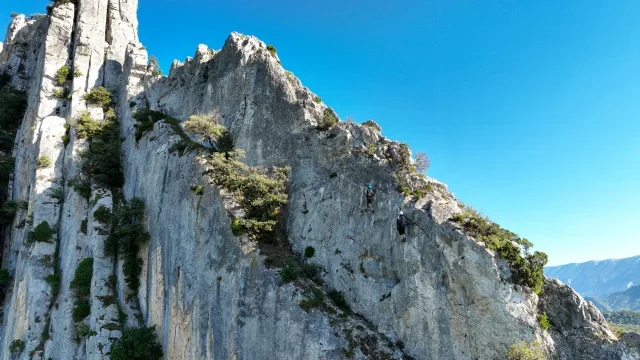
Tucked away in the Drôme Provençale region of south-east France, the Rocher du Saint-Julien offers one of the most thrilling via ferrata experiences in the country. This route climbs the dramatic limestone ridge above the village of Buis‑les‑Baronnies and delivers high-exposure traverses, suspension bridges and vertical rock faces framed by sweeping vistas. For adventurers seeking a full-on vertical playground rather than a stroll in the woods, this is a must.
Trail Overview
The via ferrata at Rocher du Saint-Julien is not just a single path: several distinct routes traverse the ridge, ranging from family-friendly lines to serious, physically demanding ascents. One source describes it as being around 1,700 m in total length and “one of the most beautiful via ferrata in France”.
Key facts at a glance:
Location: Rocher du Saint-Julien above Buis-les-Baronnies (Drôme, Auvergne-Rhône-Alpes): coordinates ~ 44.2663 N, 5.2784 E.
Multiple routes: Green (“La Pitchouno”), Blue (“La Testouriasso”), Red (“La Thiousso”), Black (“La Roumpo Quieu”) etc.
Difficulty levels from easier to very demanding: suitable for beginners/families (green) up to highly exposed and adventurous (black/red).
Vertical gain per route: around 170 m or more for the most advanced lines.
Estimated total time if combining routes: up to 6 hours for the top lines.
Route Description
Access / Start
From Buis-les-Baronnies you start by reaching the trailhead at Pin d’Aïs or another parking area below the ridge. The approach path leads up through brush to the base of the via ferrata.
The Green Route (“La Pitchouno”)
A short (~170 m) and gentle introduction including small beams, rope-nets and a light monkey bridge — perfect for children or first timers.
Intermediate / Blue Route (“La Testouriasso”)
This climbs further, with some vertical sections and a more athletic feel (~440 m length, ~2h30). Requires stronger legs and arms.
Advanced / Red and Black Routes
These are the big tests: the Black route “La Roumpo Quieu” (D/D+ rating) and Red route “La Thiousso” which ends at the summit cross of the ridge. Expect long vertical walls, suspension bridges, Tyrolean traverse options, full exposure and several hours of climbing (~3 h or more) for experienced participants.
Descent
After the summit ridge you descend via marked trail (or sometimes rappel in more technical versions) back to the valley or parking. Ensure you know which descent corresponds to your chosen route.
Highlights
Spectacular ridge line: You climb a fine serrated crest of rock that looks almost like a dinosaur’s spine, offering breathtaking views on each side into the Baronnies valley.
Suspension bridges and high-air adventure: Especially on the black/red routes you’ll traverse long footbridges, steel beams and rope bridges high above the drop.
Summit stand-out: Reaching the cross at the top of Rocher du Saint-Julien gives a strong sense of accomplishment and panorama across Provence and toward Mont Ventoux.
Varied route choices: From family friendly to advanced challenge in the same location, a rare combination for a via ferrata.
Quality limestone and sun-soaked rock: The South-facing ridge means excellent climbing conditions, warm stone and a bright setting.
Difficulty & Required Skills
For the green route – minimal technical skill, but still via ferrata equipment and a head for heights needed.
For blue/red/black – good climbing arms/legs, stamina and surefootedness are essential. Some parts are steep vertical walls and exposed ridgelines.
The black route is rated D / D+ (very difficult) in the sources.
Equipment: typical via ferrata kit (helmet, via ferrata harness + shock absorber, gloves, good shoes) is mandatory. Being comfortable at height and in exposed positions is important.
Weather sensitivity: limestone becomes slippery when wet; winds at ridge top can be significant.
Not suitable for beginners unless on the green version and accompanied by a guide.
When to Go
Best season: late spring to early autumn (May through September) when the rock is dry and warm.
Avoid after heavy rain or during thunderstorms due to exposure and metal elements.
Early morning start recommended in summer to avoid midday heat and ensure descent before late afternoon shadows.
In high summer the south face can get hot: carry water, sun-protection, and consider starting early.
Some operators note that the full experience (especially on the harder routes) is best when less crowded — early or ‘shoulder’ season may be optimal.
Access & Logistics
Nearest village: Buis-les-Baronnies (Drôme), in the Auvergne-Rhône-Alpes region, France.
Parking: several car parks at the base of the Rocher du Saint-Julien ridge (Pin d’Aïs, front de Labeaume etc).
Equipment hire / guides: Local guide services in the Baronnies region can provide gear, briefings and accompany less-experienced participants.
Time required: Depending on route, from ~1–3 hours for green/blue up to ~6 hours if combining hardest routes.
Bring: helmet, via ferrata set, gloves, water, sun protection, good shoes.
Descent: Confirm which trail you will descend on; some routes may require caution or minor scrambling on return path.
Transport: Buis-les-Baronnies is accessible by regional roads; nearest major train station is some distance away, so having a rental car or local transport is practical.
Why It Belongs on Every Adventurer’s List
Because it uniquely blends accessibility and challenge: you can start easy and escalate to serious terrain all in one location.
The ridge line above Buis-les-Baronnies is visually dramatic and unforgettable, offering both adrenaline and scenic reward.
It’s an experience of vertical playground meets panoramic alpine-Provence vibe — rarely do you get such exposure with such a southern French sun-drenched setting.
For those who love via ferrata specifically, this route offers variety in one place (bridges, ladders, vertical walls, summit finish) — making it a landmark for the sport in France.
Whether aiming for a fun, memorable outing or a serious test of mountaineering nerve, Rocher du Saint-Julien delivers on the full spectrum — making it suitable for families (green), serious trekkers (blue) and hardcore verticalists (black/red).