Via Ferrata de Thônes – La Roche à l’Agathe
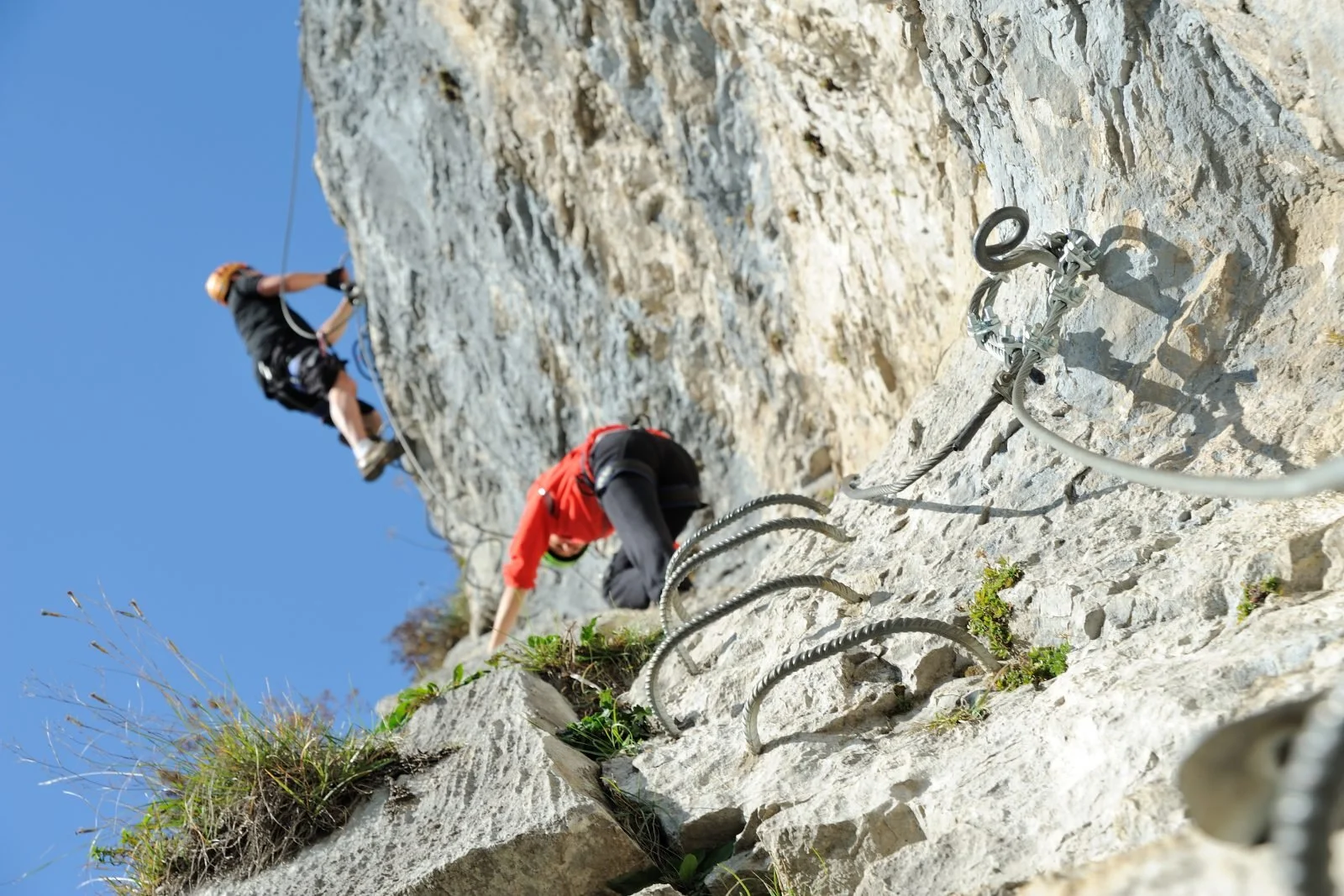
At the entrance to the Aravis massif, just above the town of Thônes (Haute-Savoie), lies one of the most spirited and vertical via ferrata routes in the region: the Via Ferrata de la Roche à l’Agathe. With dramatic overhangs, airy traverses and sweeping views of the valley below, this climb offers both adrenaline and alpine scenery. But make no mistake: it is not for the casual walker. Athletic arms, steady footing and a head for heights are required.
Location & Access
Region: Thônes, Haute-Savoie, France – near the Aravis range.
Access: From Annecy it is about a 25-minute drive (or accessible by bus) to Thônes. The via is clearly visible from the village; the parking and start are just minutes away.
Approach walk: Roughly 5-10 minutes of forest path from the car park to the base of the rock wall.
Technical Data & Route Characteristics
Vertical elevation gain (dénivelé) approx: 235 m.
Route length: ~600 m of equipped rock face.
Start altitude: ~660 m; Top altitude: ~895 m.
Orientation / Exposure: South-west facing – full sun on the wall later in the day.
Difficulty rating:
First section: D (Difficile)
Second section: D to D+ if taking the ladder exit
Alternate direct finish: ED (Extrêmement Difficult) if taking the surplomb (overhang) route.
Approximate time: 2 to 3 hours including ascent and descent.
The Route – What to Expect
Start & early sections: After the short approach you arrive at the base, and quickly are on the rock. Initial slabs and metal rungs ease you into the climb.
Monkey bridge (“pont de singe”): Very early in the route a two-wire bridge appears, raising the exposure and signaling the shift from moderate to serious.
Main traverse & steep face: A demanding traverse from right to left under steeper walls with vertical and overhanging sections. The arms are engaged, the view opens over Thônes and the valley of the Aravis.
Split decision – Ladder or Overhang finish: At roughly two-thirds height you’ll encounter a decision point:
If you want the less strenuous option, exit via a vertical ladder.
If you’re fresh and strong, you can continue via the Surplomb de l’Ermite (the overhang). This section is highly demanding, rated ED, and requires serious arm strength and no hesitation.
Summit slab & descent: After the finish you traverse easier slabs to the top. Then the descent follows via cables and forest path, roughly 30-45 minutes.
Highlights & Unique Features
Views: The route offers panoramic views of Thônes below and across to the massif of La Tournette above Lake Annecy.
Verticality & exposure: For much of the climb you are suspended over the valley, the rock wall steep and the holds vertical or overhanging.
Great equipment: The via is well-equipped and maintained, with modern steel cables and rungs; still, the physical demands are real.
Escape routes: The route provides bailout options in case you find yourself tired or uncertain—important for something rated at this level.
Who Is It For?
This via ferrata is for experienced or athletic practitioners rather than casual tourists. If you:
Are comfortable with height and exposure
Have reasonable upper-body strength and endurance
Are prepared to commit to the climb (rather than just aiming for an easy loop)
then this is an excellent challenge.
For beginners or those without previous via ferrata experience, the ladder exit is advised—or consider a less demanding route instead.
Seasonal & Practical Considerations
Because of its low altitude, the route can be done almost year-round, provided the wall is free of snow/ice.
Sun exposure: The wall faces south-west, so in summer the afternoon sun can make it very hot—early start is preferable.
Equipment required: Standard via ferrata gear (harness, helmet, via lanyards/energy absorber) is mandatory. Rental is possible.
Guiding recommended: For less experienced groups or to access the overhang safely, using a professional guide is wise.
Descent: The descent route is steep in places, and though protected by cables in parts, care is required—especially if tired.
Safety & Tips
Make sure you are well-rested and have upper-body strength: the overhang section will challenge your arms significantly.
Approach early to avoid heat and to ensure you finish descent in daylight.
Check weather conditions: rock faces can become slippery when damp.
Don’t underestimate the descent—it may be easier than the climb technically, but fatigue and loose steps can make it tricky.
If you’re unsure of your ability for the final overhang, use the ladder exit—better safe than regretting halfway up.
Carry water, snacks, and a light first-aid kit: the route itself may take ~1.5 h ascent, but approach and descent bring the total outing to about 3 h.
Why It’s Worth It
For a “half-day” adventure that packs in height, challenge and alpine views, the Via Ferrata de la Roche à l’Agathe stands out. You climb from near valley level to almost 900 m in a short time, suspended above a living alpine valley, surrounded by limestone, forest and sky. The sense of achievement is real—and the memory of the overhang and the monkey-bridge will stay long after you’re back on flat ground.