Via Ferrata Wilde Gams
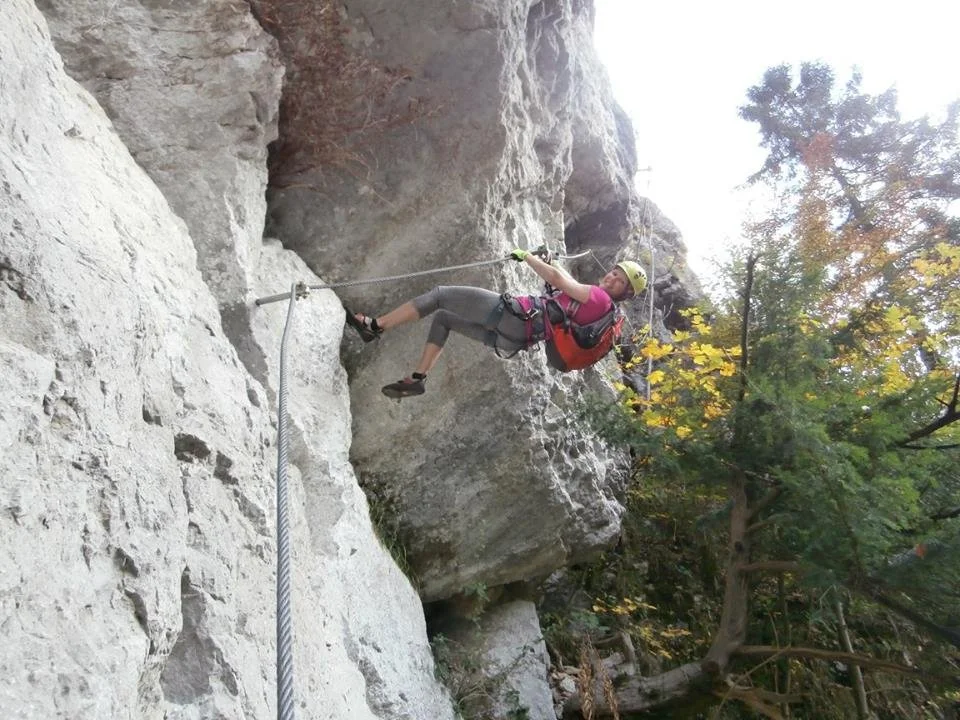
Nestled in the heart of the Berchtesgaden Alps / Leoganger Steinberge above the village of Weißbach bei Lofer in Austria, the Wilde Gams Klettersteig stands out as one of the most demanding via ferrata routes in the region. This route is tailor-made for seasoned climbers and requires not only technique but also strength, endurance and nerves of steel. It is not merely a vertical climb—it’s a full-blown athletic challenge that commands respect from the very outset.
Trail Overview
Location: Weißbach bei Lofer, Salzburg, Austria.
Height difference: Approx. 110–150 m (variously quoted at ~110 hm or ~130 hm).
Difficulty rating: up to E/F (German/Austrian via ferrata grading) in its hardest sections.
Approximate duration: Climb itself ~50–70 minutes; accounting for approach and descent ~1.5 h.
Orientation & aspect: Southwest-facing wall of Hochkranz / Leoganger Steinberge region.
Setting: Tal-nah but highly steep, featuring long overhangs and sustained vertical/overhanging plates. It is one of the “Gams” series of via ferratas in Weißbach (alongside Zahme Gams, Weiße Gams, Gams Kitz).
Route Description
From the Parkplatz or road near the village, you walk only a few minutes (~5–10 min) to the official start of the route.
Lower Section: The route opens with steep plates and well-protected terrain of difficulty around C/D, gradually warming you up but nevertheless demanding.
Middle Section – Key Challenges: You arrive at a ladder section, then cross a short grassy or mixed terrain segment before hitting the first major overhang (rated D) supported by fixed rungs and grips. Then a more intense sequence of steep plates leads into a 25-metre continuous overhanging corner/“Verschneidung” section rated E/F. This is the central crux of the climb—and many describe it as the primary test.
Upper Section & Exit: After the overhang, you face an exposed traverse/quergang, rising plates and finally a strenuous finale of D/E difficulty to the exit headwall. From the summit of the route, a path (the “Quellensteig”) leads down to the cycling/walking track and back to the village.
Descent: The descent is not trivial. From the exit, you follow a marked path into a ravine, descend to a cycle/walkway and return to the start. Under wet conditions the descent can be slippery and hazardous.
Highlights
Intense vertical and overhanging climbing: Long sustained overhangs (especially the 25 m corner) make this via ferrata exceptional among tal-nahe, easily accessed routes.
Minimal approach time: The route begins close to the village and from the parking area, making it possible to combine serious climbing with a short overall outing.
Spectacular terrain in the Alpine setting: Even though the approach is short, the geology—steep limestone walls of the Leoganger Steinberge—and the exposure give a “big wall” feeling in miniature.
A progression challenge: If you’ve done easier via ferratas (A–D) and you seek the next leap in difficulty, the Wilde Gams offers that escalation.
The cluster of routes (“Gams” trio): For those looking to sample multiple via ferratas in one area, the Wilde Gams pairs well with the adjacent Weiße Gams and Zahme Gams routes.
Difficulty & Required Skills
Difficulty grade: up to E/F—among the highest grades for a via ferrata easily reachable from a valley floor.
Fitness and strength: Excellent arm strength and endurance are required, especially through the overhangs and continuous vertical climbing. Reports emphasise “Ärmchen spürbar” (feeling it in the forearms).
Technical skills: Comfortable on steep vertical rock, great footwork on plates, and confident in exposed sections. Friends described it as “nothing for beginners”.
Equipment: Standard via ferrata set including helmet, harness, lanyards with energy absorber. Additionally a resting sling is strongly recommended so you can clip in and recover prior to difficult sections.
Conditions & caution: Wet rock surfaces, especially on the lower section and descent path, increase risk significantly. A not-insignificant descent path with exposed sections must be respected.
Navigation & route finding: The route is well-equipped with steel cables and rungs, but being able to read the rock, plan moves and gauge rest points is key.
When to Go
Best season: Late spring through early autumn (roughly June–September) when the route is dry and safe from snow/ice.
Avoid: Very hot midday sun on the exposed southwest wall, as steel cables heat up and rock may be slick.
Conditions check: Because the descent path can become hazardous when leaves or rain make surfaces slippery, select dry days and consider earlier in the day for better grip.
Crowd considerations: While not as crowded as beginner routes, in summer there may be other climbers; plan for early start to avoid congestion and better conditions.
Access and Logistics
Location: Weißbach bei Lofer (Salzburg, Austria) in the Saalachtal region.
Approach by car: From Lofer on the B 311 or from Zell am See / Saalfelden. In Weißbach head toward Hintertal, park near Café Auvogl or Gasthof Frohnwies.
Approach time to start: approximately 5–10 minutes from parking to route entry.
Public transport: From Saalfelden you can take a bus to Weißbach; the village is accessible by train/bus link via Lofer/Saalfelden.
Descent: After finishing the via ferrata, descend via the marked path (“Quellensteig”) down to the valley. Allow ~15–30 minutes for descent. Under wet or leaf-covered conditions, descent may be tricky.
Nearby amenities: The village of Weißbach offers guesthouses, restaurants and other climbing/ferrata options.
Safety note: Because of the route’s high difficulty, ensure you are properly equipped, check weather, and consider local guiding if unsure.
Why It Belongs on Every Adventurer’s List
The Wilde Gams Klettersteig delivers a rare combination of intensity, accessibility and alpine setting. Many high-difficulty climbs require long approaches or remote locations—but here you experience a “big wall” feeling just minutes from a village parking lot.
For the climber who has mastered beginner via ferratas and seeks that next serious step, this route offers pure vertical challenge, exposure, and that satisfying push of the personal boundary. It’s a benchmark for advanced ferrata adventure: neither a leisurely tourist route nor full alpinism—but the sweet spot in between, where technique, strength and route-reading matter.
Whether you’re chasing that memorable overhang, that perfect line of steel rungs or the rush of pulling through a sustained E/F sequence, this route stands out. It leaves you not only with a physical sense of achievement, but with deep respect for the rock, gear and mountain world. For those ready, it is unmistakably worthy of a place on your alpine “must-do” list.