Via Ferrata Yves Pollet-Villard
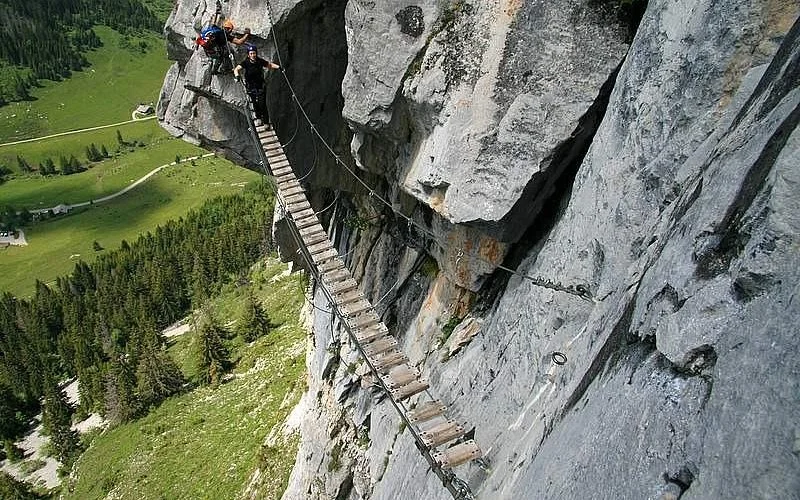
Perched high above the Aravis mountain road, the Via Ferrata Yves Pollet-Villard offers a thrilling blend of airy exposure, alpine scenery and physical challenge. Carved into the limestone of the Combe de Borderan, this via ferrata gives climbers the chance to traverse steep rock faces, cross suspension bridges and enjoy spectacular views of the surrounding Aravis range.
Location & Access
Region: Haute-Savoie, France (Aravis Massif)
Nearest village: La Clusaz (74220) – the access is by the Route du Col des Aravis.
Altitude range: approximately 1,500 m at the start to 1,800 m at the highest point.
Seasonal access: Typically open from mid-May (~May 6) to mid-November (~Nov 14) depending on snow and municipal inspection. Outside of these dates access is either prohibited or strongly discouraged.
Getting there: Drive or public transport to La Clusaz → follow signs for Col des Aravis / Via ferrata parking. A short (≈20–30 min) approach walk from the car park leads to the base.
Route Description
Length of via ferrata section: ~700 m of equipped route along the cliff face.
Vertical gain: ~300 m elevation difference.
Difficulty rating: In France the classification is D (difficult) for the full route, and with the optional overhang/variant it can reach D+.
Topographic features and highlights:
The route begins with a traverse along the rock face, then ascends via steep walls and ledges.
“Le Donjon des Deux Niches” – a steep wall section described as a key feature.
A striking suspended footbridge (“Nepal Bridge” or similar) ~20 m above the void, offering the sense of height and exposure.
The exit offers two options: a more demanding overhang route (variant) or an easier traverse path bypassing it.
Descent: From the top point the route descends via alpine path/ledges back to the parking area; the return walk takes ~40–60 minutes depending on pace.
Why it’s special
The setting is superb: the route is carved into the Borderan cliff face and overlooks the Aravis pass road, with sweeping views across alpine pastures and peaks.
It offers variety: not purely vertical climb, but a mix of traverse, ledge walking, exposure and optional “challenge” via the overhang.
Good for mixed ability: While rated D, the existence of a bypass option means it can be adapted for those who don’t want the hardest bit.
Alpine flavour: At altitude ~1,500-1,800m, the rock, the views, the context give the sense of real mountain.
Proximity to La Clusaz and road access makes it more accessible than remote big-alpine via ferratas.
Practical Information & Logistics
Equipment required: Standard via ferrata set: helmet, harness, via-ferrata lanyard (shock-absorbing), suitable footwear (mountain boots or approach shoes) and gloves are recommended. A rope may be suggested when accompanied by children or less experienced persons.
Time estimate:
Approach from parking: ~15–30 minutes.
Via ferrata climb: 2.5 – 4 hours depending on pace, group and whether you include the variant overhang.
Descent: ~45 minutes to 1 hour.
Season & Conditions: South-facing cliff means exposure to sun (and heat) in summer; rock can be slippery if wet. Snow or ice early/late season may create hazardous conditions. Access may be restricted by municipal decree if inspection not done or snow cover high.
Best time to go: Late spring (May/June) and early autumn (September) for cooler conditions and fewer crowds. Summer mornings recommended to avoid heat and midday sun.
Cost & Parking: The via ferrata is free (no specific fee) though you may need to pay for parking depending on local scheme.
Guides & Rentals: If you lack gear or are inexperienced, local guides (e.g., via the Bureau des Guides d’Annecy) offer guided outings and rental gear.
Who is it for?
Adventurous hikers comfortable with heights: though not extreme alpine climbing, the exposure and length means you should be confident with via ferrata technique.
Mixed-ability groups: The route allows bypass of the most demanding section, so less experienced participants can still enjoy much of it.
Beginners wanting to push a bit: For those who have done simpler via ferratas and want to step up, this is a good “next level”.
Not for absolute novices without any gear or without at least some experience in via ferrata/height situations.
Safety Considerations & Tips
Always check weather forecast: rain or wet rock increases risk, particularly on south-facing limestone.
Start early in the day: avoid afternoon heat, storms, or fatigue.
Confirm route is open: Check with the La Clusaz Tourist Office to ensure inspection done and no snow/ice hazards. La Clusaz
Use proper gear and inspect it: via set should be in good condition, helmet fitted, lanyards clipped correctly.
Keep aware of exposure: even traverse sections can feel high; don’t rush; take breaks as needed.
Descent path is alpine: though easier than the ferrata, the return still requires care on steep or possibly loose terrain.
Water & snacks: While the route is not extremely long, altitude and exposure add to fatigue — carry hydration and something to eat.
Sun protection: South face means sun exposure; bring suncream, hat, sunglasses.
Final Thoughts
The Via Ferrata Yves Pollet-Villard is a compelling blend of adventure, alpine scenery and technical challenge. Nestled in the Aravis above La Clusaz, it offers a memorable outing that bridges “normal hike” and “adrenaline climb”. For those seeking a via ferrata with character — solid length, scenic views, and variety in the route — this is an excellent choice.