Via Ferrata du Rocher de la Chaux
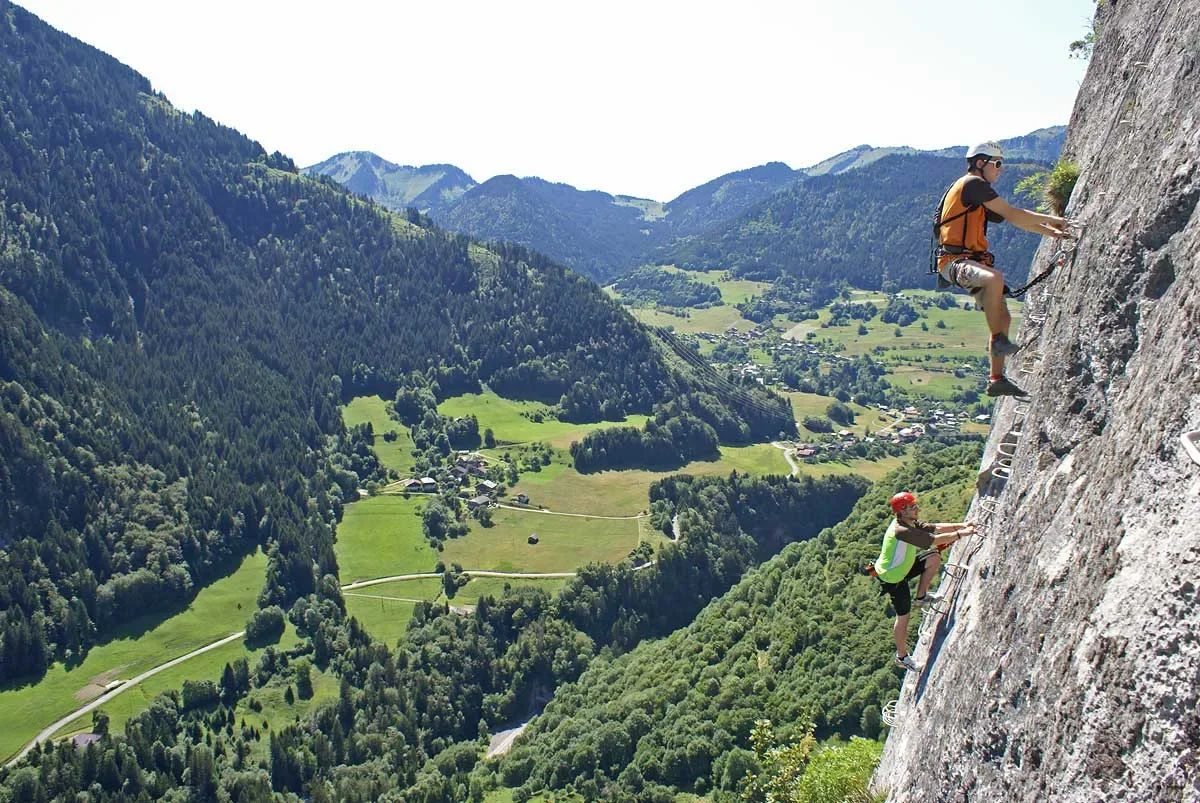
Nestled above the village of Saint‑Jean‑d’Aulps in the Chablais region of France, the Via Ferrata du Rocher de la Chaux is a thrilling vertical adventure that combines dramatic rock faces, sweeping alpine vistas and a rush of adrenaline for those keen to climb rather than simply hike. This route offers a compelling mix: easily accessible from the valley floor, yet full of punch in its exposed sections and challenging moves. For your All Hiking audience—avid outdoor enthusiasts in the Alps—this is a route that blends accessibility with alpine excitement.
Trail Overview
Location: Rocher de la Chaux (1,340 m approx.), Saint-Jean-d’Aulps, Auvergne-Rhône-Alpes, France.
Climb/vertical gain: Around 200-220 m of vertical climb (approx. 215 m climbing height).
Total route height variation: Up to ~370 m including approach and descent.
Difficulty rating: Generally rated C on via-ferrata grading scale, with a variant rated E (extra difficult) for the more advanced section.
Orientation of the rock face: Southeast facing, meaning good sunlight for much of the day, but also exposure to heat and rock-wall glare.
Duration: The climbing itself can take around 1 hour; allow 2-3 hours overall when including the approach and descent.
Season: Generally accessible from spring through autumn, although local wildlife restrictions may apply in early season.
Route Description
The route begins with a hiking approach from the valley floor—park near the cemetery at Bas-Théx and walk roughly 300 m on foot to the approach path, followed by approximately 20 minutes of steep trail to reach the start of the via ferrata.
Once clipped into the steel cable, two main variants await:
The easier route (Tête de l’Éléphant / “Head of the Elephant”): It leaves the common start and traverses a diagonal slab, then ascends a pillar to a beam crossing (“Pont de Saint Guérin”), before exiting toward the summit ridge. This section features good holds and moderate overhangs.
The advanced variant (Œil de l’Éléphant / “Eye of the Elephant”): This route pushes further to the right, tackling more sustained vertical and overhanging terrain, including a short section rated E (extremely difficult) for via-ferrata. Expect steeper rock, more demanding arm-power, and fewer easy rests.
At the top, climbers are rewarded with sweeping views over the village of Saint-Jean-d’Aulps, across to the Roc d’Enfer and even as far as the Mont Blanc massif on clear days.
For the descent, a forest trail marked “Sentier de Couteau” returns you to the valley in about 30-40 minutes.
Highlights
Scenic reward: The viewpoint from the top offers magnificent alpine vistas including Mont Blanc in the distance—a fine payoff for the effort.
Dual-variant choice: The ability to choose an easier or a harder line makes the route appealing both to strong intermediates and more advanced climbers.
Well-equipped route: Good quality fixed steel rungs, cables and structural aids make this via ferrata safe and modern.
Alpine rock feel: Although relatively accessible, the terrain conveys true alpine rock-face character—slabs, overhangs, airy traverses.
Ideal addition to your Alps-storytelling content: A complementary adventure to your hiking posts—it bridges walking and climbing, perfect for your audience of outdoor and photography-lovers.
Difficulty & Required Skills
Although this route is not the most extreme in the Alps, it should not be underestimated. Here’s what’s needed:
Physical requirement: Good upper-body strength (especially in the advanced variant), endurance to maintain focus on exposed terrain, and decent leg strength for the approach and descent.
Technical skill: Comfortable using via-ferrata gear (harness with shock-absorbing lanyards), confident on metal rungs and in places where foot-holds are limited. The advanced line may require rest-clips or a “short rope” to recover arms.
Experience: Past climbing or via-ferrata experience beneficial. The easier line is suitable for fit hikers stepping up; the harder variant is best for those comfortable with vertical exposure.
Fear of heights: Moderate to high—for both variants the exposure is real, though the easier line has more friendly angles.
Weather and rock awareness: Because the rock face is southeast-facing and partly overhanging, conditions can change quickly—especially with sun, wind or sudden storms.
When to Go
Best season: Late spring to early autumn (approximately May through October) when the route is free of snow and accessible.
Avoid early spring: Wildlife protection rules apply in some years (route might be closed around May) and late snow patches may persist on the rock face.
Time of day: Morning departures are advisable to avoid afternoon heat on the sun-soaked face and potential thunder-storms standard in the Alps in summer afternoons.
Weather check critical: Clear skies are ideal; avoid the climb in rain, wind or if the rock is wet—the metal equipment becomes slippery and lightning risk is elevated on exposed steel.
Access and Logistics
How to get there: Drive or take transport to Saint-Jean-d’Aulps, then park at the cemetery car-park at Bas-Théx (or near L’Abbaye d’Aulps) and walk approximately 300 m to the trailhead.
Approach trail: From the parking zone follow the marked path uphill (approx. +190 m climb) to the via start.
Equipment required: Via-ferrata kit (harness, shock-absorbing lanyard, helmet), gloves, good mountain footwear, and a light backpack with water and emergency gear.
Return path: After finishing the ferrata ascent, follow the “Sentier de Couteau” descent through the forest back to the valley (about 30-40 minutes).
Time budget: Allow around 2–3 hours including approach, climb and descent; if you add photo stops and rest, 3–4 hours is comfortable.
Fees/Permission: Confirm locally whether any seasonal restrictions apply (especially for wildlife).
Safety notes: Always clip in, move deliberately, and allow sufficient gap between climbers so you’re not below someone’s fall zone.
Why It Belongs on Every Adventurer’s List
For your All Hiking audience—outdoor lovers, mountain-photography fans, and adventure-seekers—the Via Ferrata du Rocher de la Chaux hits multiple check-boxes:
It’s accessible but still delivers a vertical, thrilling experience, bridging the gap between hiking and full alpine climbing.
Offers stunning alpine scenery—perfect for your brand narrative of the Alps, drone/shots and visual storytelling.
Its dual-variant design means it’s adaptable: a more moderate experience for everyday explorers, and a harder line for seasoned sharps.
It complements your hiking-trail content by offering vertical variety: a way to diversify your articles beyond long-distance trekking and make your platform a go-to for full mountain experience.
It has wow-factor: traverses, overhangs, panoramic vistas—elements that create memorable posts, reels or blog stories that resonate.
In short: it’s the kind of Alpine outing you dream about, tell stories about, and share with your community as “one of the routes you’ll remember”.