Via Ferrata de Mende – Rocher de Mende
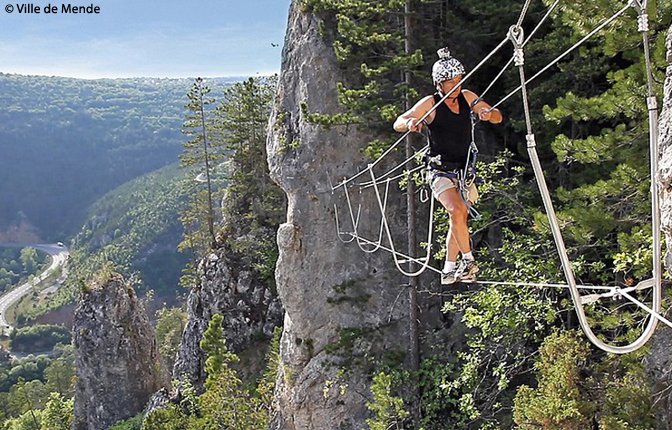
Nestled on the western slopes of the Causse de Mende, above the Lot valley in southern France, the Via Ferrata at Rocher de Mende offers an exhilarating blend of vertical rock work, suspended elements, and panoramic views. Unlike typical walking trails, this via ferrata invites you to climb, balance, and traverse – making it a perfect adventure stop for the outdoor-enthusiast. Whether you're already a ferrata-fan or looking to tackle your first one, this route delivers fun, challenge, and scenery in equal measure.
Trail Overview
Name: Via Ferrata de Mende (also referred to as Rocher de Mende or Rocher de Moïse)
Location: West flank of Causse de Mende, Lozère department, France — facing the Lot valley.
Length / Elevation: Approximate length ~ 185 m of equipped route, vertical gain about 50 m.
Duration: Between about 1 h 30 and 4 h (including access/return) depending on variant and pace.
Difficulty rating: Offers two variants – an easier horizontal route (PD: “Peu Difficile”) and a more technical route (AD+: “Assez Difficile +”).
Highlights of equipment: Nepalese bridge, rope bridge, two optional zip-lines (~35 m).
Orientation & exposure: Initially west-facing over the Lot valley, later turns south-facing, offering sun exposure and open views.
Route Description
Starting at the clearly marked parking/access path near Rocher de Mende, the via ferrata begins with a gently rising horizontal traverse along the rock face. As you follow the fixed iron rungs and cables, the terrain leads you into a rock cavity (a shallow cave in the cliff) — the juncture where the two variants diverge.
Variant Easy (PD): From the cavity, you follow more horizontal sections above the valley, cross the rope/Nepalese bridge, and eventually reach the zip-line which swings you out over the drop and returns you to the rock wall. The finishing segment remains less vertical and more scenic.
Variant Harder (AD+): At the cavity you instead climb a short vertical wall (~6 m) demanding good arm strength, then continue up to a 30-metre pillar/final vertical section that takes you to the summit exit of the ferrata. The exposure increases and the difficulty ramps up.
After exiting the climbing section, there is a marked return path leading you back down to the starting car park (approx 25-30 minutes walk).
Highlights
Unique geological setting: Clinging to the Causse de Mende plateau with sweeping views over the Lot valley and cliffs slicing down to the valley floor.
Dual-variant flexibility: You can choose between an easier and a more challenging line depending on your comfort and energy — helpful when hiking companions have mixed skill levels.
Suspended features: The Nepalese bridge, rope bridge and the ~35 m zip-line add a fun “adventure park” flavour but in an authentic outdoor mountain environment.
Accessible yet wild feel: Even the easier route gives you verticality and exposure, but the setting feels remote and scenic rather than crowded.
Great for photos/videos: The ledges, bridges and drop-outs offer dramatic angles for action shots and drone footage (where permitted).
Difficulty & Required Skills
Physical fitness: A good level of fitness is required — you’ll use arms and legs actively on some sections, especially the harder variant.
Vertical comfort & head for heights: The route includes exposed sections, drop-offs and a zip-line. Not recommended if you are uneasy in height.
Technique: Basic via ferrata kit is mandatory (helmet, harness, via ferrata lanyard with shock absorber, gloves). For the easier line you don’t require climbing rope or advanced gear, but for the harder variant firm hand-foot placement, surefootedness and upper-body strength matter.
Navigation & weather awareness: Although the route is marked, you still need to pay attention to access/exit trails and weather. Wet rock or storms make the metal rungs slippery and dangerous.
Recommendation: The harder variant is rated roughly AD+ (quite difficult) in French cotation, meaning you must be comfortable with sustained vertical sections.
When to Go
Season: The prime window is from late spring through early autumn. Outside that, weather can be colder and the rock may remain damp.
Time of day: Early morning or late afternoon are ideal — less heat in summer, better light for photography, fewer crowds.
Conditions to check: Ensure no recent heavy rain, as rock faces may be slippery and storms move in quickly in these limestone plateaux. Also confirm the zip-lines and bridgeworks are open/safe.
Avoid: Foggy or stormy days — the exposure and metal gear could become hazardous.
Access & Logistics
Starting point: Near the town of Mende (Lozère, France). Park at the designated lot for the via ferrata on the western slopes of the Causse de Mende. The brochure notes ~25 min access walk from car park.
Approach trail: Follow marked signage to the via ferrata start, through forested slopes then emerging at the cliff.
Equipment rental: Available locally for via ferrata kits (helmet/harness/longes) in Mende.
Return: Use the dedicated exit path back to the car park. Total outing time (including approach and return) increases the 1h30–3h climbing time to 2–4 hours.
Cost/access: The route appears to be free of charge (no gate fee listed) though you may pay for parking or rental gear.
Nearby services: Town of Mende offers accommodation, restaurants, provision shops for gear and meals.
Why It Belongs on Every Adventurer’s List
It strikes a perfect balance between approachable adventure and real vertical challenge: you’re not just walking a trail — you’re climbing, crossing bridges and launching off a zip-line.
The setting is beautiful and dramatic: perched above the Lot valley and set against the Causse de Mende – it offers views and context that elevate the activity into a full nature-immersive experience.
For an outdoor brand like All Hiking, it’s a great story: it’s not super remote or ultra-technical, yet it delivers novelty, adrenaline and memorable visuals — ideal for an Instagram post or blog piece with drone shots, action footage and mountain narrative.
It allows choice of challenge: whether you opt for the easier circuit or the harder pillar, you can tailor the experience to skill and ambition — which means more people can attempt it, yet still feel they’ve done “something real”.
It acts as a gateway to via ferrata: For hikers accustomed to trails, this offers a stepping stone into more vertical terrain, without immediately jumping into full alpine climbing territory.
Finally, it’s fun — the addition of bridges and zip-lines injects joy and play into the mountain experience, making it memorable for all ages.