Via Ferrata de la Roche Veyrand
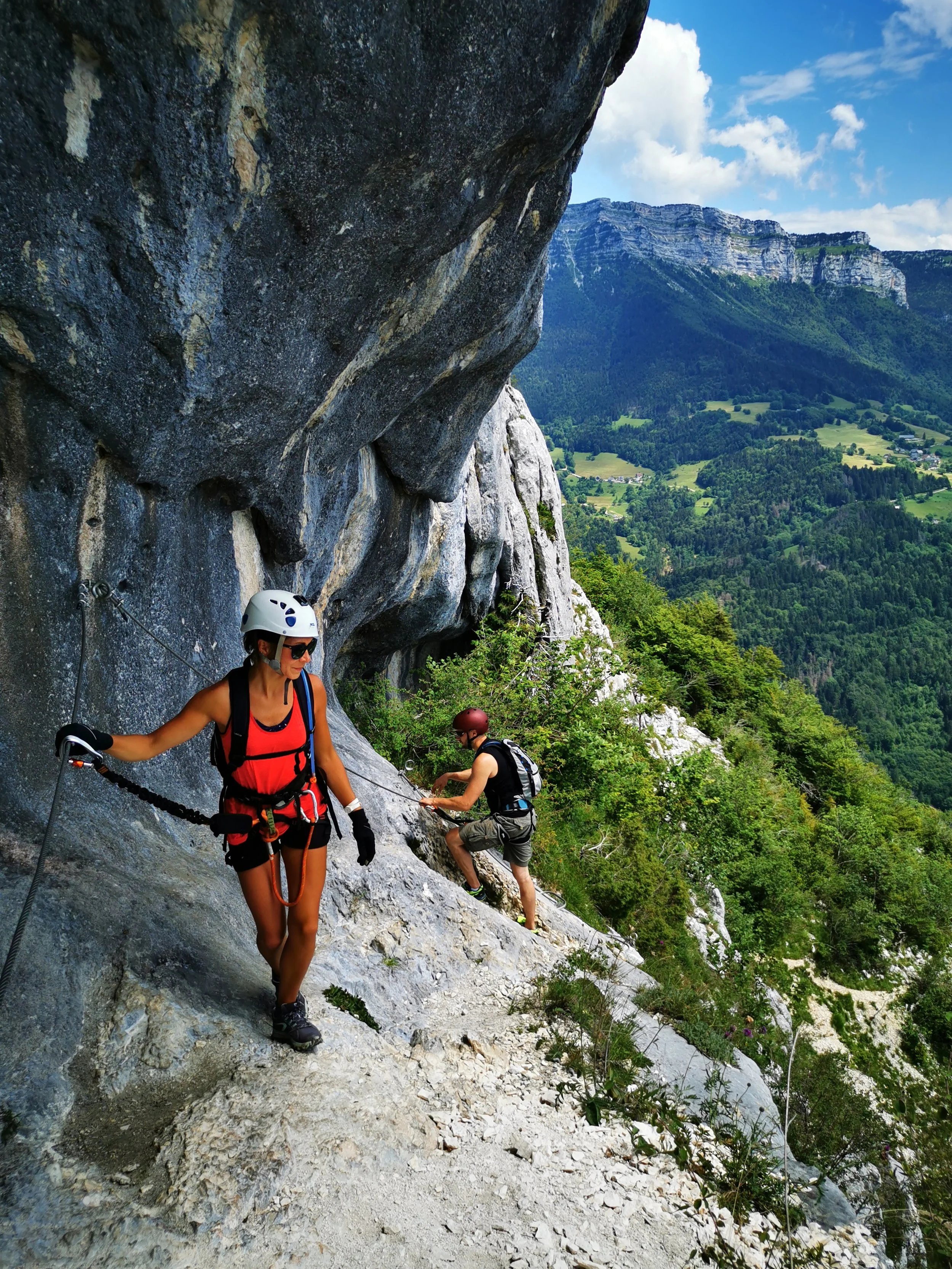
Tucked away in the heart of the Massif de la Chartreuse, between Lyon, Grenoble and Chambéry, the Via Ferrata de la Roche Veyrand is a standout adventure for climbers and thrill-seekers alike. Rising above the village of Saint‑Pierre‑d’Entremont in Savoie, France, this route combines limestone walls, airy ridges, and panoramic views, offering one of the most exhilarating via ferrata experiences in the region. With two distinct sections—one accessible and one fiercely aerial—it caters both to those new to the discipline and to seasoned ferratists looking for a challenge.
Trail Overview
Location: Saint-Pierre-d’Entremont, Savoie/Isère border, France.
Setting: A limestone cliff face in the Chartreuse massif, with high exposure above forest and valley.
Structure: Two separate but connected sections:
First section: easier, ideal for those with moderate experience.
Second section: very difficult, very vertical, high adrenaline.
Ascent: Roughly ~300 m of vertical gain on the cliff, with approach walk adding additional elevation.
Time: From about 3–4 hours (first section) to a full-day experience if doing both.
Difficulty: Graded AD for first part, TD for second (French scale: “Assez Difficile” / “Très Difficile”).
Route Description
Approach & Start: The trail begins at the hamlet of Fiolins or via a forest path from Saint-Pierre-d’Entremont. A steady ascent of roughly 30-45 minutes brings you to the base of the cliff.
First Section (Part 1): This section offers fun access into the via ferrata world: moderate inclines, footbridges, a “Nepalese bridge” (foot-bridge swing) and good rock quality with natural holds. The exposure increases gradually as you ascend.
Transition to Second Section: At the top of part one you will find a junction: you can exit via descent path, or continue to the second, harder section.
Second Section (Part 2): Here the real challenge begins. Steep vertical faces, overhangs, airy bridges, suspension elements and serious exposure. The drop beneath becomes dramatic and the moves become more physically demanding. Cliff height here rises above 250 m in places.
Descent: After the summit of the via ferrata, one of two descent paths leads you either quickly down (steep, “sentier des Clapiers”) or via a gentler forest trail (about 2 hours) through hamlets such as La Fracette and La Tournette back to the village.
Highlights
Outstanding panorama: At height, the view sweeps over the Chartreuse massif, the deep valley of Entremonts and the surrounding Alpine peaks.
Quality limestone and variety: The rock is compact and offers many natural holds; transitions from easier terrain to aggressively vertical bring variety.
Suspension bridges and high exposure: The “Pont des Balmes” and other footbridges add drama and appeal to those seeking thrill.
Two-part structure: The ability to choose first section only or complete both makes it accessible yet ambitious, broadening its appeal.
Sense of adventure: With a full-day outing and true mountain atmosphere (forest approach, cliff face, descent in the wild), it feels more like a mountaineering excursion than a simple via ferrata.
Difficulty & Required Skills
Part 1: Rated AD (fairly difficult) — suitable for intermediate ferrata participants who are comfortable with height and have basic strength and surefootedness.
Part 2: Rated TD (very difficult) — requires good fitness, strong arms/legs, no fear of exposure, and ability to handle sustained vertical climbing.
Technical skills: Use of via ferrata lanyards, helmet, harness required. You must be comfortable clipping in/out, moving steadily, and managing fear of heights.
Physical requirements: Good upper-body and lower-body strength, endurance for several hours of ascent + cliff climbing + descent.
Safety & awareness: Weather can make rock slippery; steel equipment (rungs, cables) may be slick after rain. Descent paths can be steep.
When to Go
Best season: Late spring through summer, roughly May to September. On the official site the period is given as May–September for the more aerial section.
Weather considerations: Choose a clear, dry day. Rain or recent storms make metal fittings and rungs slippery; storms in mountains bring extra risk with cables.
Time slot: Early morning start gives you cooler conditions and space away from crowds; if doing full route plan a full day.
Avoiding crowds: Weekdays or shoulder-season (May, early June, September) tend to be quieter.
Access and Logistics
Start point: Village of Saint-Pierre-d’Entremont (73670), on the Savoie/Isère border. From there follow signposts to hamlet of Fiolins or direct via trail to the base parking.
Approach walk: The trail to the via ferrata start is ~30-45 minutes of forest ascent (rough path).
Descent options: Two main descent paths – one steep and sporty (~1h30) or gentler (~2h) via forest/trails. It’s wise to know ahead which you plan.
Equipment Rental/Guides: Local companies offer guided experiences and gear rental. Particularly if you do part 2 and are less experienced, a guided outing is recommended.
Duration: If you stick to part 1 only, 3-4 hours out & back. For both parts plan 5-6 hours for the via ferrata portion + 1-2 hours for approach/descent – full day recommended.
Transportation & parking: Accessible by car; nearest major cities are Grenoble, Chambéry and Lyon. Park near Saint-Pierre-d’Entremont and follow path markers.
What to bring: Harness, helmet, via ferrata lanyard (if not renting), gloves, sturdy shoes, plenty of water, snack or lunch, sun protection, weather gear for mountain conditions.
Why It Belongs on Every Adventurer’s List
This route is more than just a via ferrata—it’s an alpine journey blending thrill, exposure, technique and scenery. Here’s why it deserves a spot on your adventure list:
Unique mountain theatre: The route pushes you up a limestone cliff in a dramatic setting, offering both mental and physical thrills.
Elevation & verticality seldom found close to major cities: Between Lyon, Grenoble and Chambéry, this accessible yet serious route is rare.
Flexible challenge: Whether you’re newer to via ferrata (first section) or a veteran seeking full day of vertical adventure (second section), there’s a fit for you.
Immersive experience in the Chartreuse massif: You leave ordinary hiking behind and step into a vertical world where the cliff is your trail.
Memorable landmarks: Footbridges, suspension elements, airy traverses—features that make it feel like a mountaineer’s route rather than just a recreational climb.
For any adventurous hiker looking to add a serious via ferrata to their résumé, the Roche Veyrand route delivers breathtaking views, physical exertion, exposure, and the satisfaction of conquering a cliff in the wild Alps. It’s one of those routes you remember for years.