Via Ferrata de la Grande Falaise
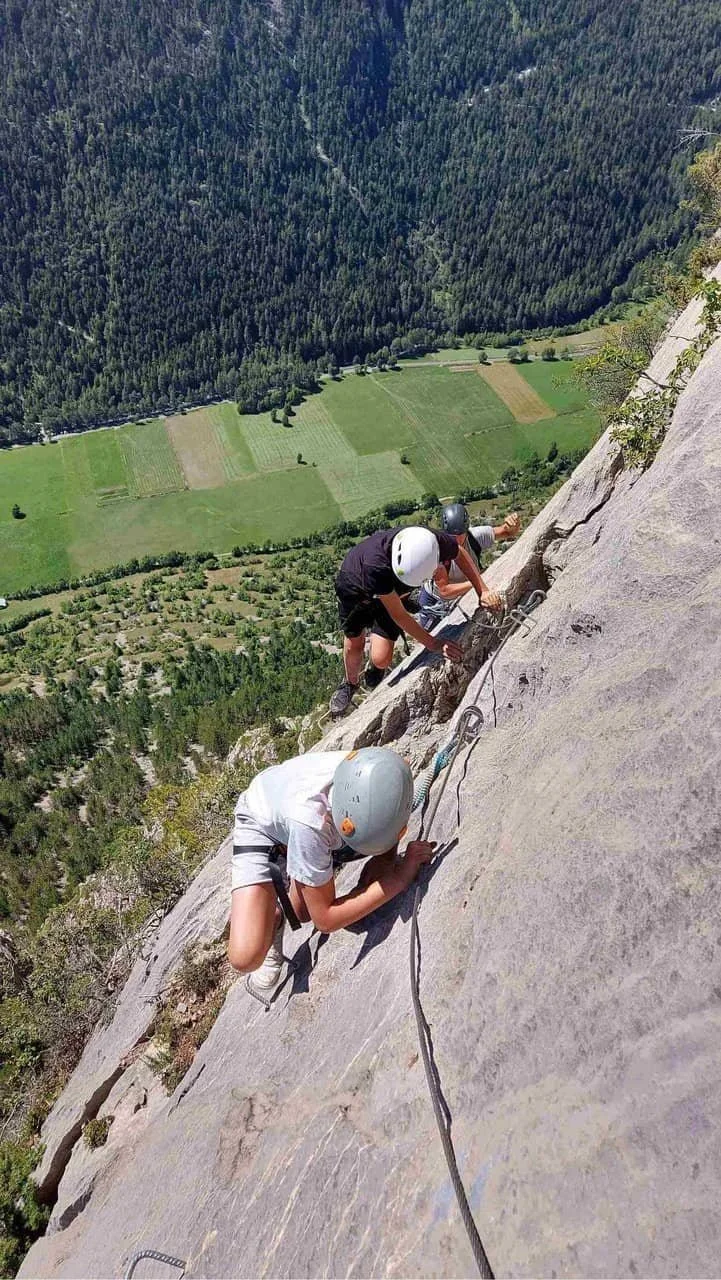
Tucked away in the dramatic limestone cliffs above the wild valley of Freissinières (Hautes-Alpes, France), the Via Ferrata de la Grande Falaise offers adventure seekers a thrilling half-day climb that blends exposure, scenery and a feel of “first of its kind”. Built in 1988 as one of the earliest via ferratas in France, this route draws you into a cliff-hanging traverse, over ledges and through airy passages, offering a potent mix of adrenaline and alpine magic.
Trail Overview
Name: Via Ferrata de la Grande Falaise
Location: Above the village of Freissinières, Hautes-Alpes, France
Vertical ascent: approximately 300 m.
Length: roughly 800 m of via-ferrata cable route.
Grade/Difficulty: French rating C/D, corresponding to “difficult” to “very difficult” in via-ferrata terms.
Time required: Approach ~25-30 minutes; route ~2 to 3 hours depending on pace and section chosen.
Season: Most of the year (south-facing limestone wall), though summer conditions are best for ease of access.
This makes it an intermediate to advanced via-ferrata — accessible for those comfortable with exposure but offering enough challenge to feel adventurous.
Route Description
The route begins with a short approach trail from the parking or village of Freissinières into the base of the cliff. From there:
First section: You climb a rocky section, then reach a traverse known as the “Corde à Nœuds” wall (rope with knots) followed by the “Minérale Gazeuse” — a long, exposed traverse with panoramic views.
Mid-section: Through a wooded terrace you reconnect with the via-ferrata cable, ascend to the “Vire aux Quartz” ledge and pass through a natural cave. The exposure increases.
Final section: The key “Dalles Osées” (daring slabs) deliver the crux: steep, exposed slabs that test your nerve and strength before the exit.
Descent: Once the cable section ends, a footpath leads you back to the valley floor, with sweeping views of the Freissinières valley and surrounding peaks.
The route is notable for using very little artificial rungs or ladders, instead emphasising contact with the rock itself — a more “natural” via-ferrata experience.
Highlights
Spectacular panorama: The south-facing limestone wall overlooks the Freissinières valley, offering wide alpine vistas.
Historic significance: Being one of France’s first via-ferratas (1988) gives the route a special pedigree.
Exposure and thrill: Traverses above the void, narrow ledges and steep slabs make the climb memorable.
Natural terrain emphasis: The route relies less on metal aids and more on rock features, enhancing the alpine feel.
Half-day format: Provides a significant adventure without requiring a full day’s commitment — ideal for multi-activity trips.
Difficulty & Required Skills
Grade C/D: Expect sustained exposure, steep sections, potentially overhanging slabs.
Physical fitness: Good upper-body strength and endurance for arm-pulling sections, along with strong legs for slabs and ledges.
Head for heights & surefootedness: Many sections are exposed; you must be comfortable with the void beneath you.
Experience with via-ferrata technique: Familiarity with via-ferrata gear (harness, energy-absorbing lanyards, carabiners) and rope-techniques is essential.
Navigation & descent awareness: The descent trail may have scree or loose sections; end-of-route tiredness can make careless steps dangerous.
Although a guide is not strictly necessary for experienced climbers, less confident participants should consider accompaniment or a guided group given the exposure.
When to Go
Best season: Late spring through early autumn (May to September) when the wall is dry and accessible.
Avoid: Early spring when snow or ice may linger on the rock; late autumn when weather becomes unstable and daylight short.
Time of day: Climbing in the morning is ideal — cooler rock and often fewer hikers; afternoons may bring heated rock and possible rockfall or sun glare.
Weather caution: Strong sun on a south-facing wall can make rock hot; storms or snow are dangerous. Check forecast and avoid thunderstorms.
Access & Logistics
Starting point: Drive or reach the village of Freissinières in the Hautes-Alpes (France).
Approach: From parking/village, it’s about 20-30 minutes footpath to the base of the via-ferrata.
Equipment required: Via-ferrata set (harness + double lanyard + carabiners), helmet, gloves, good climbing/hiking shoes.
Safety: Recommended to have first-aid kit, water, snacks; mobile phone signal may be unreliable.
Descent: The walk down from the top of the via ferrata returns via a marked path to the valley — allow time for the descent with care.
Guided option: Local guide services offer booking for this route, which can simplify logistics for those less experienced.
Transport & accommodation: Stay in or near Freissinières or the nearby town of Briançon; access by road via Hautes-Alpes region.
Why It Belongs on Every Adventurer’s List
The Via Ferrata de la Grande Falaise stands out for its blend of history, exposure, scenery and climbing satisfaction. In a world filled with “tourist” via-ferratas, this route retains a raw quality — the rock itself plays its part, the wall’s orientation and the valley view craft a dramatic setting, and the relatively short duration means you can still pair it with a hike or alpine adventure on the same day. For any adventurer who wants to feel airborne, to test their nerve and to experience one of France’s pioneering climbing routes, this via-ferrata delivers in spades.
Whether you’re a seasoned via-ferrata climber or a mountain-hiking enthusiast looking to increase your skill set, this route crafts memories: the moment you look down into the valley from a narrow ledge, the sun-warmed rock under your glove, the satisfaction of climbing slabs with minimal artificial support — it all weaves into an experience worth pursuing.